
Making Up the Menopauses

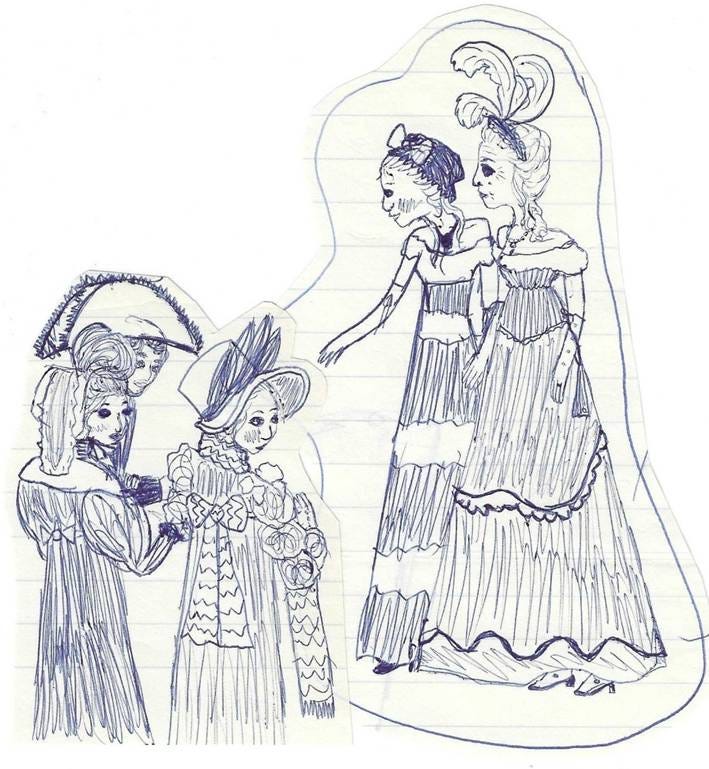
I’ve self-identified as a writer ever since I was old enough to read other people’s books. Whenever I finished a novel that I loved, I’d start writing a story in the same vein, scribbling in long-hand at my green felt card table where I was supposed to be doing my homework. Early on, I wrote Enid Blyton-type adventures or pony stories like those written by the Pullein-Thompson sisters, which I consumed voraciously. Then as my tastes matured, I moved on to the Brontës and Jane Austen.
In these early “works” of mine, I often got impatient with how long it took to write down the scenes that were unrolling rapidly in my head. So at a certain point, while I continued to make up scenes, I’d switch from writing to doodling pictures of the characters. One day I showed my mother a drawing of the characters from my quasi-Jane Austen story, and she burst out laughing. It turned out she was amused that I’d named my fictional family the Menopauses – a word that I must have heard somewhere and thought had an appropriately Georgian ring to it! (See my doodle of the Menopauses above. As you can see, I did not inherit my mother’s artistic talent.)
By the time I was 17, I was making a more sustained attempt at writing a novel. Knowing very little of life, I set it in a generic British secondary school, and – then as now drawn to the subversive and taboo – I made it about the relationship between a female pupil and a married male teacher. Being a teenager and thus drawn to drama, the subject was scandalous enough to get my creative juices flowing. Re-reading the novel now, I cringe at the dialogue but am surprised by its half-decent narrative arc.
Of course such juvenilia should probably have been thrown in a barrel and incinerated long ago, but what can I say? I’m a pack rat. I’ve dragged many a cardboard box full of papers with me across the Atlantic in the hope that they might contain hidden gems of inspiration. Besides, it’s really quite entertaining to look back at my early attempts to tell a story, much like reading old journals or letters, all of which contain echoes of my younger self.
Even lo these many years later, I continue to be stimulated by existing novels to write my own. I’m a lifelong avid reader of novels set in the early 20th century, especially those that foreground young, unmarried women. Some particular favourites off the top of my head are Howard’s End, The Forsyte Saga, and To The Lighthouse. Masterpieces all, but all of which have a missing piece at their heart from a twenty-first century perspective. None of them show (except obliquely) the implications of how society kept the young women of that era utterly ignorant about sexuality and reproduction. Obviously, it would have been impossible for those authors to have written about that subject given the constraints of the time, but it left me eager to explore how those uninformed young women might have felt and thought when the great mystery was revealed.
So I went ahead and wrote a book about that very subject. My forthcoming novel, Ancestral Virgins, set in the years before, during, and after the First World War, shows in two overlapping narratives how a young woman’s ignorance of sex could have disastrous and wide-ranging consequences. In one storyline, a young aristocrat, Celia Mapperley, who is being courted by a man she barely knows, longs to know exactly what goes on between married people behind the bedroom door. All her newly married cousin will tell her is:
“It’s nothing like you’d think. Parts of it are even quite nice. Honestly, it’s mostly just tedious, but it makes Gerald very happy.” Then she leaned forward and whispered, “I never expected to feel so… powerful.”
“Powerful? How?”
“It matters so much to him…” Emily was choosing her words carefully, “It makes him very devoted to me.”
There was a tap at the door, and the maid came in with the tea tray... Emily sat back in her armchair, and with that, the subject was closed. There was a new reserve in her, a world shared only with her husband.
In the other storyline, a young maid, Lily Hallam, is flattered but confused by the affection her employer seems to feel for her:
She’d felt no urgency from him, none of the pressing attentions that Mam had warned her about when it came to men. All he seemed to want was the lightness that they had when they were together, the lightness that helped him to forget the war for a little while. Yet there were also his kisses – long, trembling, addictive – and sometimes in the night, she’d lie awake in bed in the attic, hardly able to breathe as she relived them. It was like balancing on a very high and very narrow wall stretching far ahead and far behind. Only by taking one very careful step after another would she manage not to fall.”
For both Celia and Lily, society’s imposition of sexual ignorance leads to a lifetime of shame for the women themselves and to repercussions that reverberate through generations.
Ancestral Virgins will be published in three volumes on Friday, June 26th and will be available in both paperback and ebook form.
And who knows? Since Regency novels remain all the rage, don’t be surprised if my Menopause family makes a reappearance one of these days!
I was very rebellious as a teen too aunty oona 💚 I was too busy reading and playing sports 🤣 than boys 🤣 in high school
The Menopauses! 😅 I’d say that illustration is pretty damn good. Looking forward to seeing your novel in print. X