
Heated History

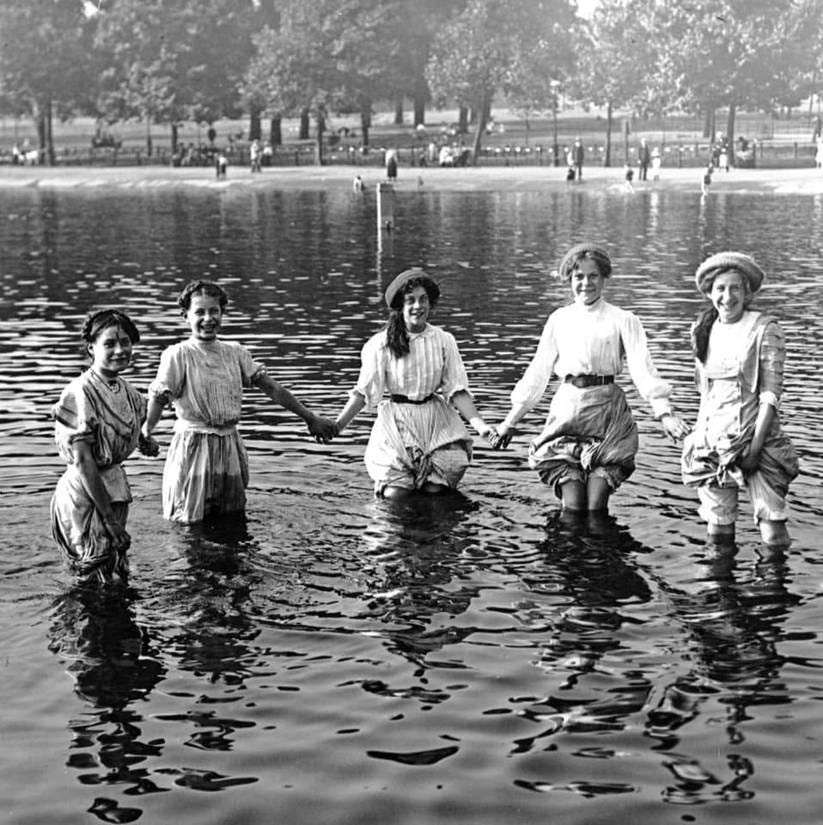
Young women cooling off in Hyde Park, London, Summer 1911
I’ve just returned from a trip to the UK, which, in common with its European neighbors, is having one of its hottest summers ever recorded. There have been repeated heatwaves since May, with especially high temperatures in the southern half of the country. Low water levels in rivers and reservoirs have led to drought conditions across all of Wales and more than half of England. As we drove along the M4 corridor from Bristol to London, scorched yellow fields stretched in every direction. The desiccation of pastureland has meant that farmers have had to feed their cattle and sheep from their precious stocks of fodder stored for next winter. The risk of wildfires has been exceptionally high, with a major blaze breaking out on Dunwich Heath in Suffolk on July 29th that quickly spread across an area equivalent to 200 football pitches.
Of course, there have been droughts and heatwaves in Britain before. For example, there was the famous summer of 1976 when my best friend and I got holiday jobs in London after our first year at university. We’d work in a sweltering office during the week and spend the weekends in Hyde Park in our bikinis, cooling our feet in the Serpentine.
Further back in time, another legendarily hot summer occurred in 1911, famous for King George V’s coronation and widespread labor strikes. In my recently published historical novel Ancestral Virgins, I’ve set two chapters on Friday, August 11th, 1911, which was believed to be the hottest day in living memory. On that stifling afternoon, my young aristocrat Lady Celia Mapperley is in the gallery of the House of Lords waiting for her father to speak in the debate on the Parliament Bill, which the Prime Minister H.H. Asquith had introduced with the aim of removing the power of the unelected House of Lords to veto government legislation.
High in the Strangers’ Gallery of the House of Lords, heat gathered in the rafters of the vaulted ceiling like smoke. All along the gallery, ladies dabbed their cheeks and foreheads, the plumes of their hats bobbing, like birds perched along a telegraph wire. Dampness pooled in the small of Celia’s back and crept around the crease of her waist. She tried to imagine jumping into the lake at Mummersford, the chill of the brackish water, the bracing gasp, but when she opened her eyes, there, once again, was the flaring red of the chamber, the long strings of words floated upwards in fragments.
Meanwhile, on the same broiling hot day in rural Nottinghamshire, five-year-old May Hallam is attending her father’s funeral, fascinated by the black horses pulling the hearse and not entirely understanding the enormity of her loss.
The hot air pressed against her like rabbit fur. She breathed it in, feeling it warm on the insides of her nostrils and the insides of her eyelids. There was no escape from the clutch of it. In the winter you could wear two pairs of socks inside your boots, wrap yourself in a horse blanket and crouch by the fire. Or run up and down the hill to Granny Maitland’s to get your blood up and your limbs loose and warm. All there was in summer was the pond, skittered with duckweed and yellowing teazles.
While those summers were long and uncomfortable to live through, today’s heat is more relentless. In the 21st century, each year’s high temperatures exceed those of the year before till we can feel the very fabric of the planet stretched to the limit. It almost makes me envy our ancestors who didn’t have to worry whether the world would still exist for coming generations. But there were other cataclysmic dangers ahead for Celia and May in 1911. By the conclusion of the novel, twelve years have passed. By 1923, the lives of both young women have been changed beyond recognition by love, sex, and war and by the thin line they must always tread between convention and disgrace.