
Belfast Calling
My first novel and what became of it

Many thanks to all of you who have liked, commented on, and reposted the covers of my forthcoming three-volume historical novel Ancestral Virgins since they were revealed on May 11th. And a big thanks to all my new followers here on Substack. You’re coming in thick and fast, and all I can say is, the more the merrier!
Before Ancestral Virgins comes out, I’ll be telling the story of how it came about, why it had such a long gestation period, and why I’ve chosen to publish it in three volumes just like the Victorians used to do.
But today I want to pick up the thread of my writing journey at the point where I began to make a serious effort to write a proper grown-up novel.
I was in my mid-30s when I decided to take a class at the Writers Center in Bethesda, a suburb of Washington D.C. (https://writer.org/) This amazing institution has fostered the careers of hundreds of local writers by providing top-notch classes in fiction, non-fiction, scriptwriting and many other aspects of the business. The class I took was a turning point for me, not only for what I learned but because of the sense of belonging I experienced. It’s hard to explain to people who don’t write fiction why I have this absurd compulsion to make up stories, but at last, I found myself in a harshly lit basement with a bunch of other people who had the exact same irresistible urge. And just like that, I found the community I’d been craving (not to mention three inspiring and talented women who have become friends for life).
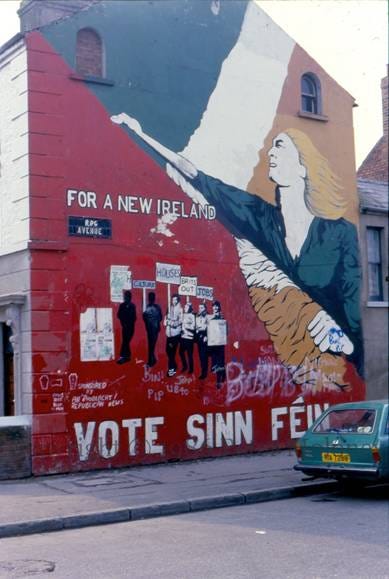
During the course of the class, I wrote a short story about the Troubles in Northern Ireland that was loosely based on the short time I spent in the province in the mid-1980s. When I shared it with the group, the workshop leader turned to the last page and said, “So what happens next?” Now that’s a sentence every writer wants to hear because it’s a sign that you’ve succeeded in drawing the reader into the world you’ve created.
So I took my short story and worked out where it could go.
What I came up with was a political thriller and whodunnit. The protagonist of the book was a journalist called Sandie Gillespie, a wilder, darker, and much braver version of me. Bruised by a doomed love affair and confused about what she wanted to do with her life, she threw herself into finding out who was behind the assassination of the charismatic leader of Sinn Fein, the political wing of the IRA.
After the book had been read by several friends and colleagues whose judgment I trusted, I began sending it out to literary agents. As most of you probably know, agents have always acted as gatekeepers for traditional publishers, weeding out books that they deem to be non-contenders and signing up only those that they consider to have commercial potential. For many years, they were also honest brokers for their authors, nannying them and nurturing their careers. Therefore, the first step in every writer’s dream was to land an agent.
These days a submission package can be sent at the touch of a button, but back then, it had to be sent by snail mail. This was time-consuming and cost me a lot of money as I was sending most of my packages to agents based in the UK. In stark contrast with today, in those days, agents could be relied upon to reply, not always in any detail but at least enough to make me feel my work had not been ignored. I soon collected a decent pile of rejections, most impersonal – “Our list is extremely full” “We’re not taking on any new clients at the moment” – but some both personal and mildly complimentary – “The writing is strong, and the characters are well-drawn and authentic.” “We were impressed with your fluid and arresting style.” “The story is well-written and has a wonderful pace.”
All very nice to hear, but way or another, the answer was always no. So when my phone rang one day and a plummy British woman’s voice asked, “Is that Fiona J. Mackintosh?” I had zero expectations until the caller introduced herself as Pat Kavanagh, and my jaw hit the floor. Kavanagh was then the doyenne of British literary agents, doubly famous for being married to the acclaimed novelist Julian Barnes, and on that call, she told me she might be interested in representing my novel.
It was a real thunderclap moment, the kind of moment that writers dream of. Vistas seemed to spread out in front of me as the golden gates of literary London opened to admit me. But you’ve probably already guessed that this opportunity failed to materialize and those gates stayed firmly closed. By the time I’d gone backwards and forwards with one of Kavanagh’s fellow agents about tweaks to the manuscript, the Good Friday Agreement in April 1998 had brought the Troubles era to an end, and the literary world decided that no-one wanted to read about it anymore.
These kinds of disappointments happen all the time in my line of work. If anything, they’ve become even more common. Agents who nurture their authors and coax the work from them are now a rarity for anyone who doesn’t consistently sell millions of books, leaving aspiring writers to plow our own furrow. Who could blame us for finding more enjoyable ways to spend our free time than writing stories that may never be read by anyone but our nearest and dearest?
But over the years, I’ve discovered a deep-seated masochist streak in myself. When knocked down, I give myself a minute or two to wobble and then get back in the fray. It wasn’t long before I was deep into another project – non-fiction this time – that absorbed a decade of my life and took me over 6,000 miles from my home to one of the world’s most beautiful tropical islands. And almost got me a book deal into the bargain. Stay tuned to Tales from the Midatlantic for the next episode!
Wow - how exciting about PK! Xx
I enjoyed reading how you described your experiences and it's left me wondering, what happens next? :) I can imagine a book about the Troubles would become popular again at some point.